The new schedule for the reunion is at Reunion 2018. If you have any comments on the schedule or the reunion in general, please click on the comments link at the top of this entry. That will let you comment. I’ll review and approve family comments daily.
Flying off of an aircraft carrier is the highest challenge aviation has to offer. But in a helicopter? That seems like it’s cheating. If you don’t like the way your approach is going you can stop, even back up if you like, and think it over. Not like the crash or dash approach in a tactical jet approaching at 140 knots.
But the Navy didn’t want us helicopter pilots on an aircraft carrier to get bored. So they gave us other interesting challenges. Imagine landing in a spot roughly two feet larger than your helicopter while approaching the carrier from the bow. As you get slow you’re actually backing up over the ocean while you approach the carrier. How about taking off perpendicular to the carrier’s path through the water at night in bad weather?
I learned to handle all of that. Then one day I was flying off the USS Wasp (the World War II carrier, not the modern Wasp) in a dense fog. Returning from a tactical flight I flew down the approach path, guided by the calm voice of the radar controller. When we got to minimums the carrier was still shrouded in the fog, I could see nothing. I followed the missed approach but realized this wasn’t going to be any more successful a second time and I was low on fuel.
The controller had me go back to the radar approach but instead of descending at a gentle angle I dropped right down until I could see the water and slowed down far below normal approach speed. I was still being directed toward the carrier but at about twenty feet above the ocean. Someone on the carrier started dropping smoke flares off the stern. A smoke flare floats, has a readily visible burning flame just above the surface and emits a lot of smoke.
As I slowly flew up the track of the ship I started seeing the smoke flares, just like Hansel and Gretel’s bread crumbs, leading to the ship I followed the trail of smoke flares up the wake of the ship until I got so close I could see the water roiled up from the screws. I climbed fifty feet until I was above the flight deck, then eased slowly forward until the carrier appeared out of the mist. I set down on spot 9, the furthest aft helicopter landing zone on the flight deck. I couldn’t see anything forward of spot 8 through the fog. We had about 250 pounds (roughly 30 gallons, about what my SUV holds) of fuel remaining. Enough to fly another fifteen minutes. Piece of cake!
Inspired by a visit to Montana and seeing Granny Fritz’s personal photo album I have been researching her life and in particular her parents, John Patrick “Jack” Lee and Mary Geary.
Jack Lee was born in Spidal, County Galway, Ireland on March 3, 1852 to Patrick Lee and Kate Malloy. According to several census documents he arrived in the U.S. in 1870, although when he arrived in Montana is unclear so far. Once settled in Fort Benton, Montana Territory he became a well-known stage driver between Fort Benton and Fort Macleod in Alberta, Canada. This trail was known as the Whoop-Up trail, primarily because it was a thoroughfare for liquor delivered by steamboat to Fort Benton, which was the furthest point of navigation on the Missouri River. The major trade in liquor to the First Nations in Alberta was over by 1874 although general trade continued on the trail until 1890 when competition from the railroads overwhelmed it.
Jack Lee was featured in several mentions in the River Press of Fort Benton regarding his comings and goings on the trail. Once on Christmas Eve, 1884 he set out for Fort Macleod when the temperature the night before had fallen to 30 below zero. According to family lore he also worked on keelboats on the river.
He filed a land claim for 172 acres on the Marias River northeast of Fort Benton. The date he filed is uncertain. His avowed purpose was stock raising and the claim was perfected in 1904 and again in 1925 for some reason.
Mary Geary was born on June 12, 1864 in Ontario, Canada to Thomas Geary and Mary O’Hara. According to the 1900 census she arrived in the US in 1886. In a college paper Lucy Fritz related some memories of her father, William Lee Bill Fritz.
According to him, William and Charles Conrad came to work for I.G. Baker and the three of them formed I. G. Baker, Bro. and Co. William Conrad went looking for a governess for his children and came back from Ontario with Mary Geary, then 22.
“This courageous young woman,” Lucy continued, “cared for and instructed the Conrad children. She also passed on her knowledge to the other children in town as one of the first school teachers.”
Jack and Mary were married on April 23, 1889 and the newspaper announcement said that they had already moved into “a cozy little home.” When the Conrads moved on to Kalispell her job as governess ended. But in 1891 they had two little girls (not twins!), Mary Helen in January and Catherine Anne (my grandmother) in November.
According to Lucy’s memories, Mary Geary Lee was a member of the board of the first Choteau County Library when it opened in 1916. Her picture resides in the Agricultural Museum of the Northern Great Plains.
Sometime in the 1920’s the Lees moved to Los Angeles, CA. The second record of their land claim in 1925 may have had something to do with this move. If anyone in the family knows the story of this move send it to me and I’ll make it the subject of a future post.
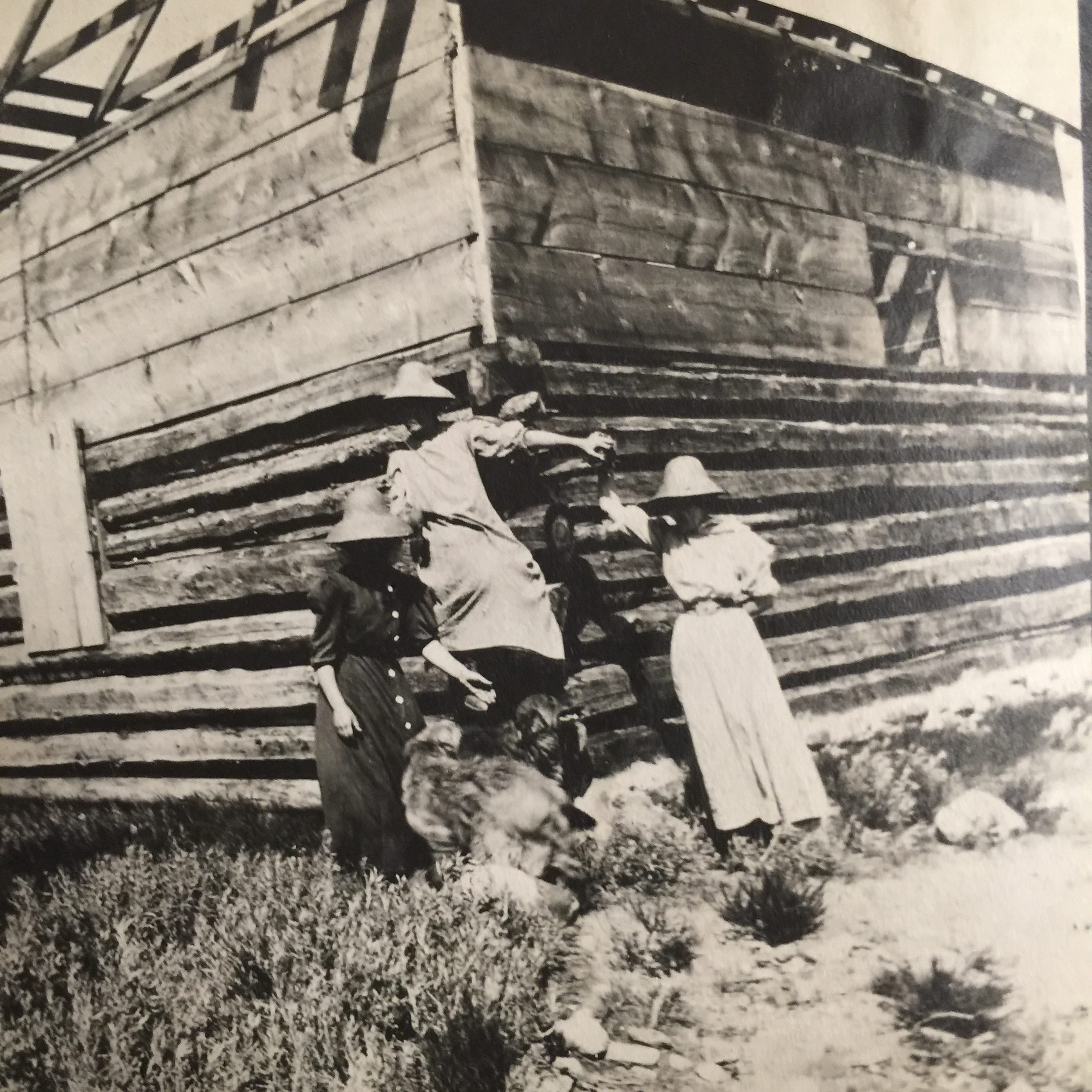
This is the homestead that the Lees lived on the Marias River outside Fort Benton.
The Anaconda Standard, Sunday Morning, June 19, 1892. Butte, Montana
The Proprietor of the Board of Trade Gambling House Cashes In
Butte, June 18. – William, or as he was better known “Billy,” Fritz, proprietor of the Board of Trade saloon and gambling house, died suddenly in his home, No. 19 East Porphyry street, at an early hour this morning from hemorrhage of the lungs. He was taken sick about 11 o’clock Thursday night. The funeral will take place from his late residence at 3 o’clock tomorrow afternoon.
Mr. Fritz had resided in Butte for about 18 years and was one of the best known men in the camp. He was familiar with all its early history and was well acquainted with many of the stirring scenes which were enacted here in the early days. He formerly worked for H. G. Valiton about 12 years ago when the latter was running a livery stable on West Park where the Maule block now stands. He worked there for two years and was foreman of the stable for about a year after it was removed to the corner of Park and Main. When the stable was sold to Owsley & Carr he quit and in 1882 he opened the Board of Trade saloon and gambling house. Up to that time, it is said by his friends, he had never taken a drink in his life. It is also said that he never gambled himself or played a game of cards. The Board of Trade was a profitable investment and he accumulated wealth at a rate which soon made him independent. He was always very reticent about his monetary affairs and never told anyone how much he was worth, but it is thought that he left property and money to the value of nearly $75,000. It is not known that he left any will and the property will probably all revert to the widow and two children who survive him.
This was the obituary of the original William Fritz, my great-grandfather. According to his marriage license he was from Williamsburg, NY, where he was born in December 1849. Williamsburg was a German section of what is now Brooklyn, NY. He would have been 43 years old at his next birthday.
According to this obituary he came to Butte, Montana in about 1880, at which time he was about 29 years old. I have no information as to what he did in the years between 1849 and 1880. If anyone reading this blog has any information at all about his early life I would appreciate it if you would put it in a comment so it can be shared with the rest of us.
RIP, Grandpa Billy
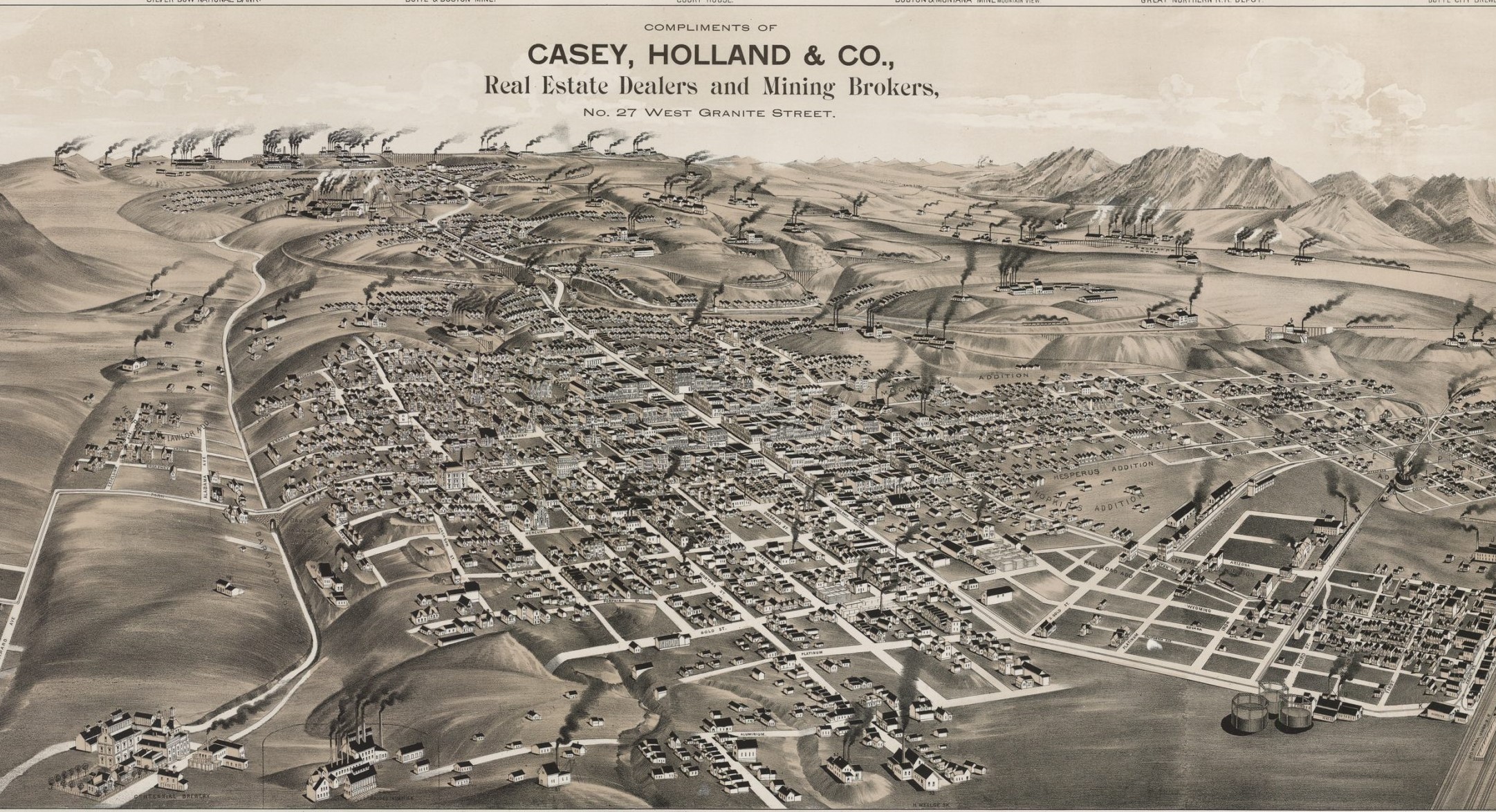
Henry Wellge, Perspective Map of Butte City, Mont. County Seat of Silver Bow County. 1890. Milwaukee, 1890.
I’m writing this as I visit Bill and Alice Fritz at their home in Stevensville, MT. During our conversations Bill shared some newspaper articles about Great Grandpa Fritz. I’m going to insert the most interesting one below. His obituary I’ll save for a future post.
The Anaconda Standard April 30, 1891
Butte, April 29. “Billy” Fritz attended “Muldoon’s picnic” today as an honored guest. Yesterday Fritz, in a moment of drunken passion, struck Louis Herman, a messenger boy, who asked him to pay for a call. The boy’s face smarted greatly, as did also his wounded pride, and he went to Judge Muldoon’s court and filed complaint against the burly assailant. Fritz was arrested, and for insulting the court was committed to jail for 24 hours. This morning his honor relented and gave an order for Fritz’s release. Fritz was then placed on trial for striking the boy, and a clear case was made against him. After giving him a lecture on the cowardice and brutality of a man who would strike a little boy, his honor fined Fritz $25 and costs, amounting in all to $54. Fritz then left, but instead of profiting by his experience he immediately proceeded to get drunk again and started in search of trouble.
I said in an earlier post that I knew very little about Grandpa Fritz other than he was a saloon owner. His obituary confirmed that he was known as “Billy” and does give more information about him to be added later. This article does flesh out his portrait, even if not in a good way. More to come, none of bad, at least for now.
The McElligott clan is a big part of our heritage. An Irishman (actual, from Ireland) I once met told me (not in a friendly way) that the McElligott name sounded Scottish to him. It stuck with me and today I was browsing the Internet when I found a site dealing with Irish names of Norman origin. The site is found at: Norman-Irish Surnames where a simple search on McElligott turns up:
in part 2
by Paul McCotter Anglo-Norman surnames fall into diverse categories, reflecting the multi-ethnic origins of the colonial population as referred to in Part I of this series. Four basic categories of surname exist: patronyms, formed by the Christian name of an ancestor; toponyms, taken from a placename associated with an ancestor; surnames consisting of the nickname of an ancestor; and surnames denoting the ethnic origin of an ancestor.
Patronyms
Patronyms similarly cross ethnic boundaries. French examples include the Cork name Garrett and the Kildare/Tipperary/Galway name Hacket (Haket). The rare Cork surname Hankard appears to derive from the Flemish Christian name Tancard. The Wexford surname Lambert is similarly derived from a Flemish Christian name as is the Waterford Wyse (Wyzo). Many patronyms were formed from Anglo-Saxon (pre-Norman English) Christian names. Examples are: Aylward (Waterford/Kilkenny) Aylmer (Kildare) Esmond (Wexford) Everard (Tipperary).
The Leinster patronyms Wogan (Gwgan) and Howlin (Hwlyn) are of Celtic Welsh origin. Of particular interest are that small group of patronyms preceeded by ‘Fitz’, from the French fils, ‘son of’. In this category are the names FitzGerald, FitzMaurice, FitzGibbon, FitzSimmons and FitzHarris. The Kerry surname MacElligott was originally FitzElias. Confusingly however, the Laois/Kilkenny surname FitzPatrick is not of Anglo-Norman origin but was the form adopted by the native Mac Giolla Phádraig family, anciently kings of Ossory, due to pressures of anglicisation.
and in part V,
McElligott This family descend from Elias fitz Norman, one of the early settlers who acquired lands in Waterford, Tipperary and Kerry, and who died around 1214. His eldest son, Richard, inherited the east Munster lands, which soon passed to the Rokelle family via his granddaughter Margery; her descendants now bear the Waterford surname Rocket. In time the name born by the descendants of the younger son, William fitz Elias, who had inherited the Kerry lands, transformed itself via Gaelic into McElligott. The family were prominent gentry in that county until the seventeenth century dispossessions and the surname remains common there today.
This seems to be the earliest reference available, but stay tuned for further developments.
And here’s a post in a message board from someone searching for some related families.
The book “Families of County Kerry” – says this about MacELLIGOTT.
Mac Elligott (it’s listed under the letter ‘E’)
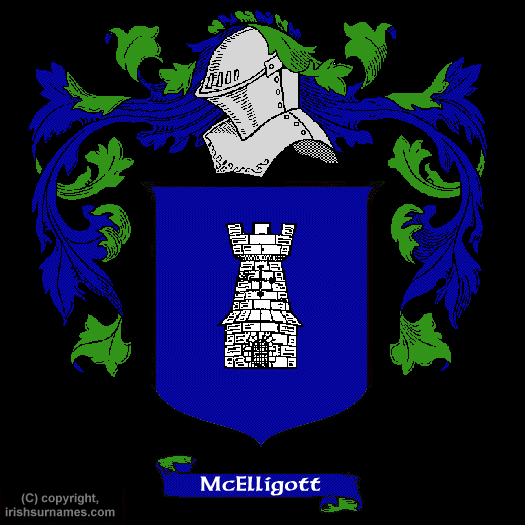
Some 103 Macelligott families are given in Co. Kerry. Anciently the family lands were between Listowel and Tralee and Castleisland, and the castles of Carrignafeela, and Arabella and Bernagrillagh were held by them in ballymacelligott. The family arms are given by King as azure, a tower triple towered, argent; the crest a falcon rising, wings expanded and endorsed proper; the motto: Si Deus Quis contra.
Mary MacElligott in 1297 was the wife of Maurice Fitz Maurice and she had as her marriage dowry the lands of Galey, O’Brennan and Cloghanmackin. In 1584, Ulick Mac Thomas Eligot of Carrignefeilge held Bally Mac Elligott and Tullygarron, which were granted to Sir T. Roper in 1613. In 1588, Morris mac Eligott held Ballygrillaghe Castle. In 1597, the lands of Thomas Mac Elligott in Galey and of John Mac Thomas, were granted to Edmond Barrett and Wm. O’Ronan and George Isham and Thomas Fitz Maurice, the Baron of Lixnaw. In 1619 John Mac Elligott, son of Thomas and nephew of Maurice, inherited the family estate in Ball Mac Elligott and Ballyseedy parishes; he was the son in law of Bishop Crosbie and sold Tulligarron to Daniel Chute in 1630, when the latter married his daughter, Johanna.
In 1653, Edmond of Galey and Mce. of Bally mac Elligott were forfeiting proprietors. Edmond Mac Gerald Mac Elligott of Ballydonohuein Galey was pardoned in 1594, and from him was descended Edmond of Ballylongford b. 1749, whose tomb is at Lislaghtin Abbey; his daughter Mary 1785-1871, M. Ryan of Kilrush; his dau. Margaret b. 1800, married D’Arcy of New York. His son Michael 1776-95, d.s.p.; his son Gerald b. 1792, m. Ellen O’Connor of Listowel, having Gerald, b. 1828, m. Eliz. Adams of Listowel, having Gerald d. 1885; Edward d. 1871; John m E. cussen and dsp. 1896.
In 1688, Col. Roger Mac Elligott of Bally Mac Elligott raised a foot regiment which served in England, and was M.P. for Ardfert in 1689; he surrendered Cork city as Governor in 1689, fought at the Battle of the Boyne, was a prisoner in the Tower of London until 1697; was exchanged to France and took command of the regiment de Clancarty of the Irish Brigade. His son, Capt. Charles, won the Cross of St. Louis at Fontenoy in 1745. J. King reported that Dr. Maurice g. Mac Elligott was researching Austria and Europe for individuals of the name and listed several of the family members found in his work. Several of the name are found in the Austrian Army, including Baron MacElligott who was born at Tralee in 1752, entering that army in 1770 and was buried at Saint Jakob’s Church in Brunn.
This is another old family of Co. Kerry, from whom the parish of BallymacElligot is said to be named. One account gives the name of MacElligot to actually be a form of McLeod. Lodge’s Peerage says that in the 13th century that a Fitzmaurice was married to the daughter of Sir John McLeod of Galway, and that others of this family of McLeod settled in Co. Kerry. The name of McLeod was changed to MacElligot, thus giving the MacElligot family a pedigree from the noted Scots clan McLeod. Of the reliability of this I do not know. Others have said MacElligot is a truncated form of MacGillicutty, (i.e. Mac Gillicut = Mac Elligott).
Not really McElligott’s Castle ruins, but it might look like the actual Irish castle ruins.
Ballingrilough Castle belonged to the MacElligotts. (BallyMacElligott Parish). Carrignafeela, the stone fort of the poets, was another macElligott castle, where Arthur Denny died in 1619. As Tralee was in ruins, the Dennys used this castle as the manor house in 1588. It was afterwards the home of Wm. Ryeves and Alice Spring. Mr. Verdon lived here in 1756. Arabella was a third castle of the MacElligotts.
Chute Hall (1846) was acquired by marriage from the Mac Elligotts in 1630 by Daniel Chute. Richd. Chute lived here in 1756.
In “The History of Ballymacelligott and Its People”, published 1997 by Ballymacelligott Active Retirement Association, Printed by Kingdom Printers. (Paperback, 156 pages). On page 13 is a somewhat rambling article “McElligott’s Castle” attributed to Fr. John O’Donovan (1841), which begins: “In the centre of the townland of Arabella in this parish are the ruins of a castle called McElligott’s Castle. Nothing remains of it at present, but traces of a foundation and a portion of one wall, thirty feet in length and about twelve feet in height at the south east corner.”
It seems the castle was wrecked by Oliver Cromwell & Co. (Charles Sullivan)
So it would seem that my Irish “friend” bears a grudge that dates to the 13th century. But I have seen at least one site, of questionable reliability, that says the McElligott clan is of Pictish origin, predating Gaelic Scots. If so, our family was displaced over two millennia ago by the Gaelic invaders. Talk about a long-standing grudge. Middle East, move over!
This post is personal, history for future generations.
In 1969 I got my Navy wings and was assigned to a Navy helicopter squadron deployed aboard USS Wasp, an antisubmarine aircraft carrier. I spent the first half of the year learning to hunt submarines and fly the SH-3 helicopter. In September we went to NAS Quonset Point where we would be until 1972. In October I went to sea for the first time.
I was very new to shipboard life but the most enjoyable part was flying. One day early in the cruise I was flying in the right seat (the aircraft commander seat) when a call came to pick up a Navy Captain, the commodore of the destroyer squadron accompanying us, from a destroyer and take him to the Wasp. I had never trained in this maneuver but you don’t switch seats in flight in a helicopter so my aircraft commander, LCDR Zahn Hausmann, said he’d talk me through it.
The Commodore’s destroyer had only a small helicopter deck, not big enough to land an H-3 so we had to pick him up with the rescue hoist. This involved hovering over the aft deck of the destroyer and lowering the rescue hoist attached to a personnel sling. The Captain would get into the sling, we would hoist him up and bring him inside, then heard for the Wasp. Piece of cake.
The only problem is, when hovering you can’t see the deck, only the side of the destroyer, from the pilot’s seat. The copilot can’t see much of anything but ocean. Zahn told me to just watch the ocean and just glance occasionally at the ship, which was wallowing at a very slow speed in the swell. For a while it went well, but at one point I fixated for a moment on the ship just as it took a vicious roll to the left, toward the helicopter. I instinctively pulled away from the ship, taking the cyclic stick with me. Immediately the helicopter began to move back and away, not far but enough.
During this maneuver the crewman in the back who ran the hoist was talking me through staying on the right spot with statements like “easy back” or “easy left”. At this point he said “easy right”, then his voice rose and he said “forward” followed by “Altitude!” Unbeknownst to me, as the moment I lost focus the Commodore was being lifted from the deck and his feet were just barely touching it. I moved back and he was then forward of the hoist. When his feet left the deck he began to swing back toward the centerpoint of the hoist, just as I moved the helicopter forward. After the backswing, he began swinging forward (a bit faster) toward the hangar on the deck. In response to my crewman’s command for altitude I pulled in quite a bit of power and he was unceremoniously jerked off the deck and just missed hitting the hangar with his foot. Well, not exactly unceremoniously. As he was lifted into the air the destroyer’s bosun was piping him overboard and everyone on the deck was saluting.
I, meanwhile, was terrified. I could see my career going up in smoke. I asked the crewman how the Commodore looked when they got him inside. He said the Commodore looked kind of gray and wasn’t saying anything. We deposited him on the carrier and heard no more about the incident, although he did ask that someone else take him back to the destroyer. In the course of the next couple of years I got better at the job. My last retrieval was from the deck of a surfaced submarine, which was completely invisible from my position. I had to rely entirely on the hoist crewman, and it went just fine. Not a bad end for such an inauspicious start.
This blog was created with the idea of bringing together information about our families of origin from extended family members. Although I understand a lot of you have been reading this blog, I have gotten only three comments from family members, mostly a variation of “cool!”. I am hoping for a more interactive forum since it takes time to manage a blog and I lose interest when I am not getting feedback. Please give me snippets of family lore! You will get attribution in posts to keep the memories alive.
The Fritz/McElligott clan also inherits from two other families: the Lee family from Canada/Ireland and the Fehrenbach family from Gengenbach, Baden-Wurttemburg, Germany. This post refers to the Fehrenbach family. I am planning a post about the Lee family as well and would appreciate any information you have in the form of comments to this blog. I will incorporate new information into the Lee family post with attribution.
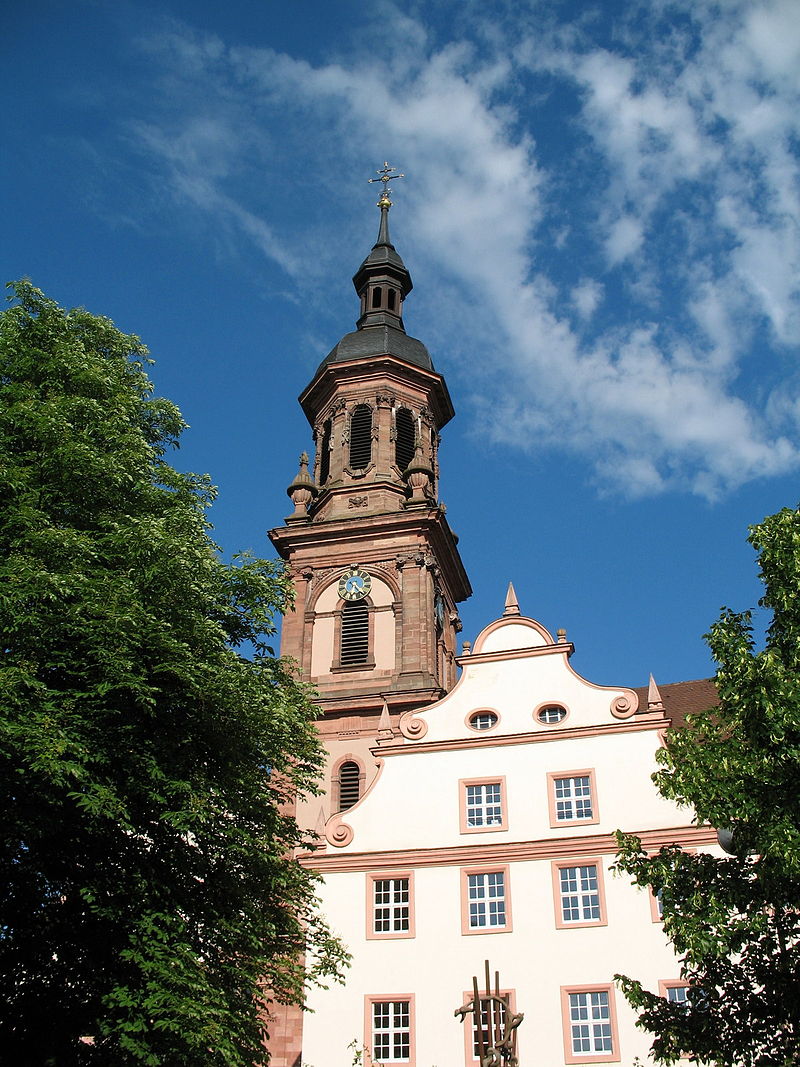
Kloster Church in Gengenbach
The Fehrenbach clan has a long history in the Black Forest town of Gengenbach. The earliest ancestor I have found is Michael Fehrenbach, Grandma Helen’s 4th Great Grandfather, who was born in Gengenbach some time in the late 17th or early 18th century. There was a steady line of Fehrenbachs in Gengenbach direct to Grandma Helen. My sister Ruth Doherty has done significant research on the family through her connections in Germany and hopefully she will provide some additional insight.
Gengenbach is a beautiful town that several of us have visited. To me it looks like the Disneyland version of Germany except it’s real. People live in these homes and run these shops. Gengenbach was founded in the 13th century and became an Imperial Free City in 1360. However, its history goes back further to the founding of a Benedictine monastery by Archbishop Pirmin († 753) at the mouth of the Kinzigtal at the western edge of the Black Forest. The abbey was founded with the support of the Frankish Count Ruthard, and with its designation by Pope Innocent II as a free abbey became the justification for designation of Gengenbach as a free Imperial city.
The last Fehrenbach of our line who lived and died in Germany was Meinrad Fehrenbach, a master butcher who married Balbina Anna on September 24, 1846. I have actually seen their signatures in the marriage register of the Kloster. Their son Joseph apparently left Gengenbach around 1880 to come to America. I have only one, rather unflattering picture of Joseph with his sons, which I won’t publish here. Maybe someone can find more.
Grandma Helen is the daughter of Joseph and Stephanie Lienhard from the nearby town of Altdorf. They came first to Michigan and then in the mid-1880’s moved to Kansas City. I don’t have any information about their marriage but Joseph did marry Theresia Biedermann on June 3, 1875 in Gengenbach. I have as yet no further information about Theresia, who was 33 years old at the time. Joseph and Stephanie had seven children: Joseph, John, Rosa, Daniel, Mary, Barbara and Helen. I have yet to meet someone named Fehrenbach to whom I wasn’t related (including in Germany, although that was a bit iffy) , as the family is relatively small and the family name uncommon outside the Black Forest region.
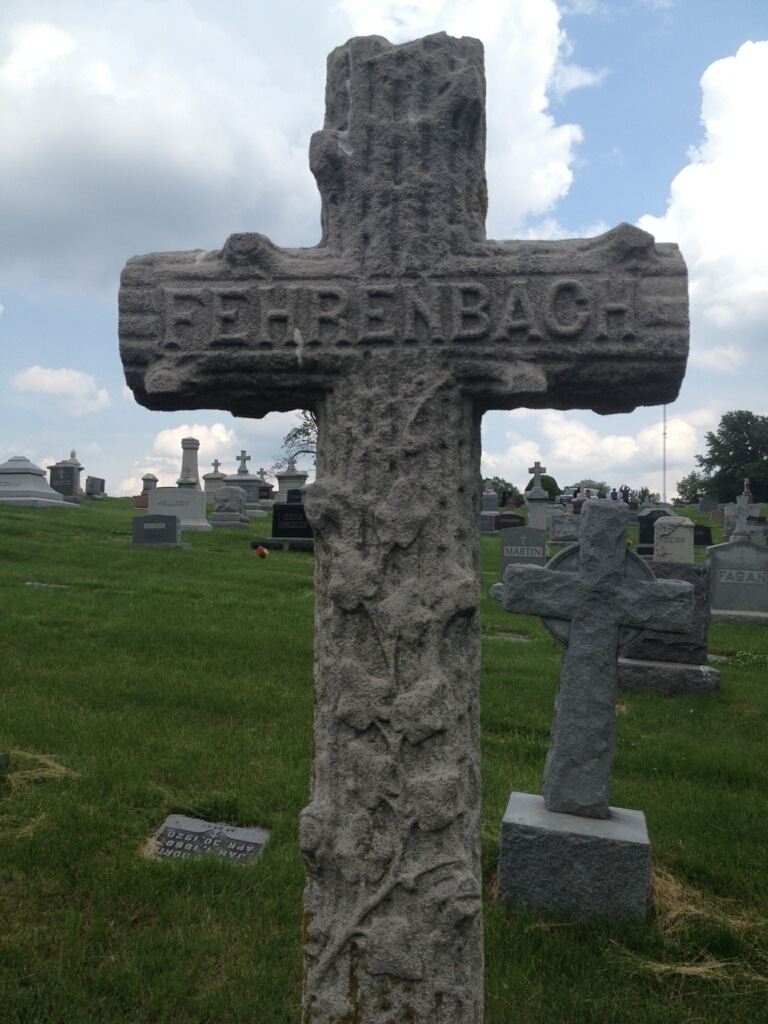
Fehrenbach memorial in Kansas City
Joseph died on June 14, 1914 in Kansas City. Stephanie died on January 18, 1949 at our Aunt Barb Parnacott’s house in Kansas City. I do have a vague memory of her in her room (I was five when she died, so it’s feasible it’s a real memory) before she died. I would really like to find out when and where they were married and what happened to Theresia Biedermann in Gengenbach. If anyone has information about this, please share it.
The first in a long line of William Fritzes was our great-grandfather William Fritz.
I have very little information on him. I know he owned the Board of Trade saloon in Butte Montana from 1891-1892′ that he lived then at 19 E Porphyry St., that he married Melvina Hampton House on October. 7, 1887 and that he died in June 1892 and was buried in Mount Moriah cemetery in Butte. His marriage license gave his parents names as Joseph Fritz and Caroline Noeck. He was born Dec. 7, 1849 in Williamsburg, N.Y.
In 1954 Mom developed severe rheumatoid arthritis, which I think was mainly in her knees. She was confined to bed for a period of several months. She told me not too many years ago that she first realized it was happening when she tried to get out of bed and couldn’t walk. She had to crawl on the floor to get anywhere.
I know it was in 1954 that she came down with it because Lois was a baby. I remember that she went to doctors, who couldn’t help her. Arthritis was a great unknown in those days. While Mom was sick, she and Dad hired a young African-American named Caroline to help take care of us. Caroline was only 17, but she seemed grown to me at 10. She cooked and cleaned for us and took care of Lois. The cooking was a big deal since in those days of stay-at-home Moms, our school made anyone who lived within 6 blocks of the school go home for lunch. Caroline was very affectionate with Lois and I have very fond memories of her and all she did for us.
Mom was always very positive during this time, which must have been hard. I remember that while she was in bed she was engaged in entering contests, which were popular in the newspapers in those days. I think they asked for submissions for advertising slogans and jingles, or something like that. I don’t know that she ever won anything but she never gave up.
The episiode lasted for months. The arthritis finally went into remission some time in the winter of 1954-55, Mom said that she recovered when she became pregnant with Chris. Even so, its effects remained. In her latter years she suffered badly from deteriorated knees.She took Naprosyn until the side effects made it impossible to continue. Then she just coped. If asked she would tell me about her pain but she never complained. I do know that when she moved to Leisure World in 2000, she was glad to be away from the stairs in their house on Tamarack Lane.
I do not remember a single time during those days when she was bitter, depressed or anything else. She must have had those times but she kept them to herself. She made me feel as though everything was going to be all right. In the end it was.
Here is a picture of Mom in her bedroom with Larry and Ruth, on what I think must have been Larry’s First Communion Day. She was beautifully made up, as I remember her still during those months.
I know that Larry and Ruth must remember some of those times and I hope they will contribute their memories as well.