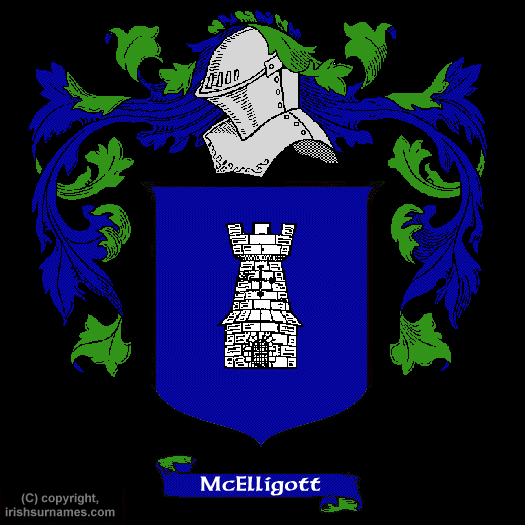
 The McElligott clan is a big part of our heritage. An Irishman (actual, from Ireland) I once met told me (not in a friendly way) that the McElligott name sounded Scottish to him. It stuck with me and today I was browsing the Internet when I found a site dealing with Irish names of Norman origin. The site is found at: Norman-Irish Surnames where a simple search on McElligott turns up:
in part 2
by Paul McCotter
Anglo-Norman surnames fall into diverse categories, reflecting the multi-ethnic origins of the colonial population as referred to in Part I of this series. Four basic categories of surname exist: patronyms, formed by the Christian name of an ancestor; toponyms, taken from a placename associated with an ancestor; surnames consisting of the nickname of an ancestor; and surnames denoting the ethnic origin of an ancestor.
Patronyms
Patronyms similarly cross ethnic boundaries. French examples include the Cork name Garrett and the Kildare/Tipperary/Galway name Hacket (Haket). The rare Cork surname Hankard appears to derive from the Flemish Christian name Tancard. The Wexford surname Lambert is similarly derived from a Flemish Christian name as is the Waterford Wyse (Wyzo). Many patronyms were formed from Anglo-Saxon (pre-Norman English) Christian names.
Examples are: Aylward (Waterford/Kilkenny) Aylmer (Kildare) Esmond (Wexford) Everard (Tipperary).
The Leinster patronyms Wogan (Gwgan) and Howlin (Hwlyn) are of Celtic Welsh origin. Of particular interest are that small group of patronyms preceeded by ‘Fitz’, from the French fils, ‘son of’. In this category are the names FitzGerald, FitzMaurice, FitzGibbon, FitzSimmons and FitzHarris. The Kerry surname MacElligott was originally FitzElias. Confusingly however, the Laois/Kilkenny surname FitzPatrick is not of Anglo-Norman origin but was the form adopted by the native Mac Giolla Phádraig family, anciently kings of Ossory, due to pressures of anglicisation.
and in part V,
McElligott
This family descend from Elias fitz Norman, one of the early settlers who acquired lands in Waterford, Tipperary and Kerry, and who died around 1214. His eldest son, Richard, inherited the east Munster lands, which soon passed to the Rokelle family via his granddaughter Margery; her descendants now bear the Waterford surname Rocket. In time the name born by the descendants of the younger son, William fitz Elias, who had inherited the Kerry lands, transformed itself via Gaelic into McElligott. The family were prominent gentry in that county until the seventeenth century dispossessions and the surname remains common there today.
This seems to be the earliest reference available, but stay tuned for further developments.
And here’s a post in a message board from someone searching for some related families.
The book “Families of County Kerry” – says this about MacELLIGOTT.
Mac Elligott (it’s listed under the letter ‘E’)
Some 103 Macelligott families are given in Co. Kerry. Anciently the family lands were between Listowel and Tralee and Castleisland, and the castles of Carrignafeela, and Arabella and Bernagrillagh were held by them in ballymacelligott. The family arms are given by King as azure, a tower triple towered, argent; the crest a falcon rising, wings expanded and endorsed proper; the motto: Si Deus Quis contra.
Mary MacElligott in 1297 was the wife of Maurice Fitz Maurice and she had as her marriage dowry the lands of Galey, O’Brennan and Cloghanmackin. In 1584, Ulick Mac Thomas Eligot of Carrignefeilge held Bally Mac Elligott and Tullygarron, which were granted to Sir T. Roper in 1613. In 1588, Morris mac Eligott held Ballygrillaghe Castle. In 1597, the lands of Thomas Mac Elligott in Galey and of John Mac Thomas, were granted to Edmond Barrett and Wm. O’Ronan and George Isham and Thomas Fitz Maurice, the Baron of Lixnaw. In 1619 John Mac Elligott, son of Thomas and nephew of Maurice, inherited the family estate in Ball Mac Elligott and Ballyseedy parishes; he was the son in law of Bishop Crosbie and sold Tulligarron to Daniel Chute in 1630, when the latter married his daughter, Johanna.
In 1653, Edmond of Galey and Mce. of Bally mac Elligott were forfeiting proprietors. Edmond Mac Gerald Mac Elligott of Ballydonohuein Galey was pardoned in 1594, and from him was descended Edmond of Ballylongford b. 1749, whose tomb is at Lislaghtin Abbey; his daughter Mary 1785-1871, M. Ryan of Kilrush; his dau. Margaret b. 1800, married D’Arcy of New York. His son Michael 1776-95, d.s.p.; his son Gerald b. 1792, m. Ellen O’Connor of Listowel, having Gerald, b. 1828, m. Eliz. Adams of Listowel, having Gerald d. 1885; Edward d. 1871; John m E. cussen and dsp. 1896.
In 1688, Col. Roger Mac Elligott of Bally Mac Elligott raised a foot regiment which served in England, and was M.P. for Ardfert in 1689; he surrendered Cork city as Governor in 1689, fought at the Battle of the Boyne, was a prisoner in the Tower of London until 1697; was exchanged to France and took command of the regiment de Clancarty of the Irish Brigade. His son, Capt. Charles, won the Cross of St. Louis at Fontenoy in 1745. J. King reported that Dr. Maurice g. Mac Elligott was researching Austria and Europe for individuals of the name and listed several of the family members found in his work. Several of the name are found in the Austrian Army, including Baron MacElligott who was born at Tralee in 1752, entering that army in 1770 and was buried at Saint Jakob’s Church in Brunn.
This is another old family of Co. Kerry, from whom the parish of BallymacElligot is said to be named. One account gives the name of MacElligot to actually be a form of McLeod. Lodge’s Peerage says that in the 13th century that a Fitzmaurice was married to the daughter of Sir John McLeod of Galway, and that others of this family of McLeod settled in Co. Kerry. The name of McLeod was changed to MacElligot, thus giving the MacElligot family a pedigree from the noted Scots clan McLeod. Of the reliability of this I do not know. Others have said MacElligot is a truncated form of MacGillicutty, (i.e. Mac Gillicut = Mac Elligott).
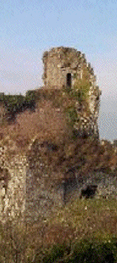
Ballingrilough Castle belonged to the MacElligotts. (BallyMacElligott Parish). Carrignafeela, the stone fort of the poets, was another macElligott castle, where Arthur Denny died in 1619. As Tralee was in ruins, the Dennys used this castle as the manor house in 1588. It was afterwards the home of Wm. Ryeves and Alice Spring. Mr. Verdon lived here in 1756. Arabella was a third castle of the MacElligotts.
Chute Hall (1846) was acquired by marriage from the Mac Elligotts in 1630 by Daniel Chute. Richd. Chute lived here in 1756.
In “The History of Ballymacelligott and Its People”, published 1997 by Ballymacelligott Active Retirement Association, Printed by Kingdom Printers. (Paperback, 156 pages). On page 13 is a somewhat rambling article “McElligott’s Castle” attributed to Fr. John O’Donovan (1841), which begins: “In the centre of the townland of Arabella in this parish are the ruins of a castle called McElligott’s Castle. Nothing remains of it at present, but traces of a foundation and a portion of one wall, thirty feet in length and about twelve feet in height at the south east corner.”
It seems the castle was wrecked by Oliver Cromwell & Co. (Charles Sullivan)
So it would seem that my Irish “friend” bears a grudge that dates to the 13th century. But I have seen at least one site, of questionable reliability, that says the McElligott clan is of Pictish origin, predating Gaelic Scots. If so, our family was displaced over two millennia ago by the Gaelic invaders. Talk about a long-standing grudge. Middle East, move over!